
by Fabiola Rodea Loza
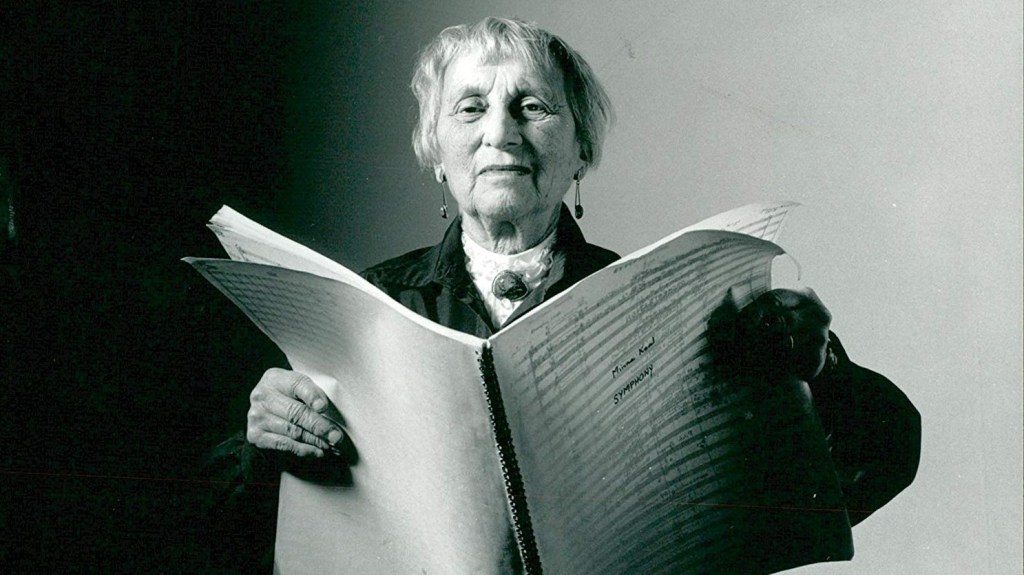
Minna Keal was not only one of the finest contemporary composers gifted to us in the last century; she remains an inspiration. She was a determined woman whose age did not diminish her dreams. When her moment arrived, she seized it magnificently, imparting to us the sense that anything is achievable.
Born in London in 1909 to Russian immigrants, in a household where Yiddish was spoken, Minna discovered music through her mother, who sang Jewish folk songs, and her uncle, who played the violin. This exposure ignited her passion for music.
In 1928, at the age of 19, she decided to pursue formal composition studies at the Royal Academy of Music. However, tragically, her father passed away, and she had to abandon her studies to work and support her family. With this, she bid farewell to music for over forty years.
In 1939, she joined the Communist Party, but in 1957, she left the party due to the Hungarian invasion. She married twice and had one child.
During the war, she established an organization to rescue Jewish children from Germany.
I thought I was nearing the end of my life, but now I feel like I’m just beginning. It’s as if I’m living my life in reverse.
Minna Keal (1989)
For most of her life, she worked as a secretary. During this time, she also taught piano lessons. When she retired at the age of sixty, almost by chance, she decided to resume her music career, which had been on hold for so long.
One of her piano students was to be examined by Justin Connolly, a composer and professor at the Royal College of Music. Upon hearing the excellent performance of her student and witnessing the quality of the compositions, he asked to see more of Minna’s work, which she had already archived.
After reviewing her work and getting to know Minna, he encouraged her to consider resuming her career. By 1975, Minna was a student of Connolly. She initially resumed her music lessons and later pursued composition, eventually becoming one of the finest contemporary European composers.
Her String Quartet, Op. 1, was completed in 1978 and premiered for the first time in 1989. The Wind Quintet, Op. 2, followed in 1980. After taking lessons with Oliver Knussen in 1982, she finished her four-movement Symphony, Op. 3, which was broadcast on BBC in 1988 and performed at the BBC Proms in 1989. Cantilation for violin and orchestra, Op. 4, was completed in 1988 and had its premiere in 1991.
Between 1988 and 1994, she worked on the Cello Concerto, Op. 5, which was later recorded by Alexander Baillie and the BBC Scottish Symphony Orchestra, conducted by Martyn Brabbins, for the NMC label. On the same recording is her Balada (1929) for cello and piano, where Alexander Baillie is accompanied by pianist Martina Baillie.
Her first symphony was premiered in 1989 at the BBC Proms, annual concerts held at the Royal Albert Hall in London, and it was a resounding success. Minna was eighty years old at the time, and from that moment until her passing, she devoted herself entirely to music.
«I thought I was nearing the end of my life, but now I feel like I’m just beginning. It’s as if I’m living my life in reverse,» she said after her premiere at the Proms.
 Cielito Arte